Young children are naturally curious. They love asking questions, exploring new ideas, and figuring out how things work. This curiosity makes the preschool years the perfect time to introduce STEM learning. The best part is that you don’t need expensive toys or a science lab to get started. Many engaging STEM activities can be done right at home using everyday household items.
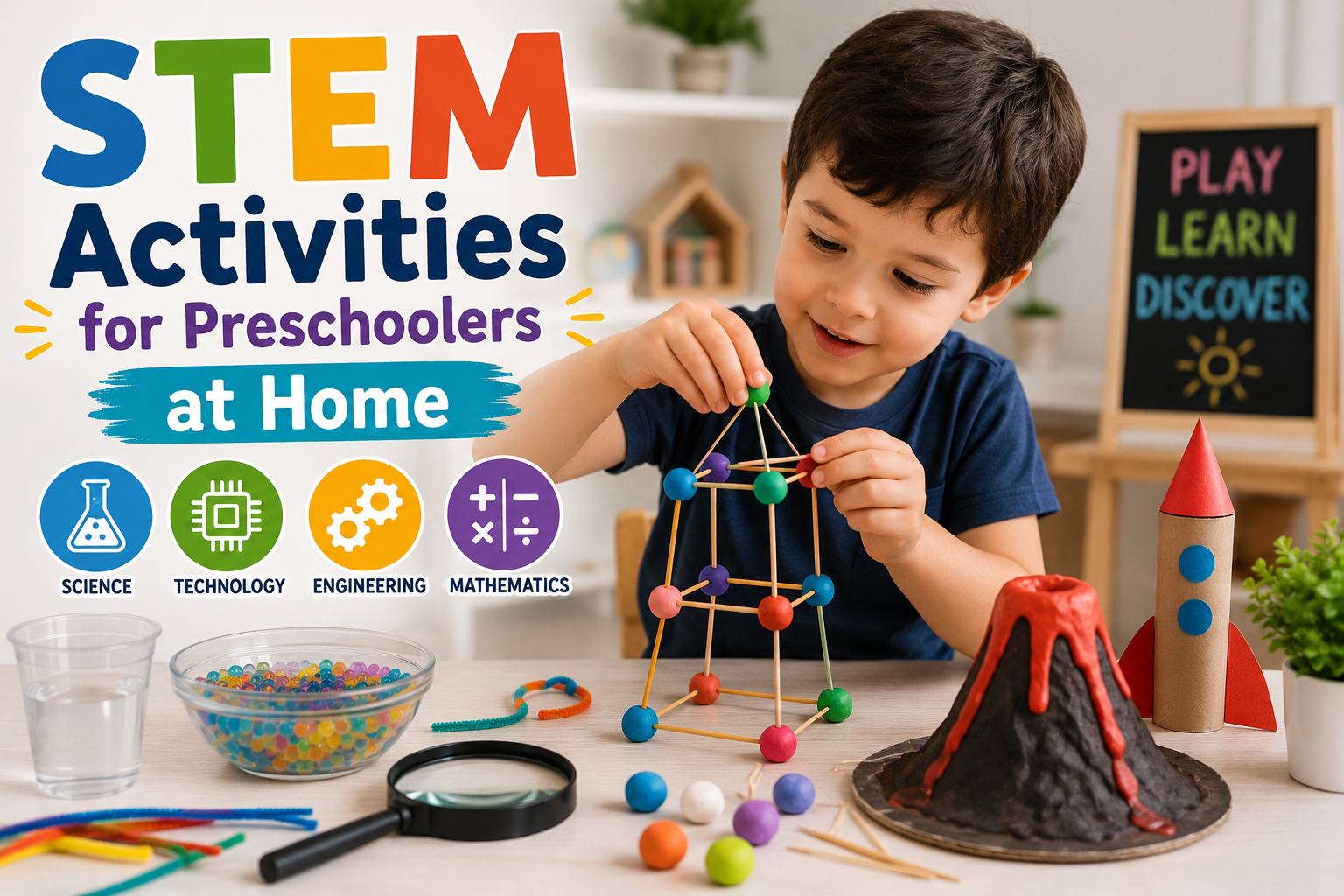
STEM stands for Science, Technology, Engineering, and Mathematics. These four subjects help children develop essential skills such as problem-solving, creativity, critical thinking, observation, and teamwork. For preschoolers, STEM is not about memorizing facts or solving difficult equations. Instead, it’s about learning through hands-on exploration, asking questions, and discovering the world around them.
If you’re looking for simple and enjoyable STEM activities for preschoolers at home, this guide will help you create meaningful learning experiences that encourage curiosity and build confidence.
Why STEM Learning Is Important for Preschoolers
Children begin developing important thinking skills long before they enter kindergarten. Introducing STEM concepts during the preschool years helps build a strong foundation for future learning.
Benefits of STEM activities include:
- Encourages curiosity and exploration
- Develops critical thinking skills
- Improves problem-solving abilities
- Strengthens fine motor skills
- Builds creativity and imagination
- Introduces early math concepts
- Supports language development
- Promotes teamwork and communication
Most importantly, STEM activities teach children that it’s okay to make mistakes. Trial and error are valuable parts of learning.
Make STEM Learning Fun
Preschoolers learn best through play. Rather than focusing on perfect results, encourage your child to experiment, ask questions, and try different solutions.
Ask open-ended questions like:
- What do you think will happen?
- Why did that happen?
- Can we build it another way?
- What should we try next?
These conversations help children develop reasoning and communication skills while making learning enjoyable.
1. Build a Tower Challenge
Gather items from around your home, such as:
- Plastic cups
- Building blocks
- Cardboard boxes
- Empty tissue boxes
- Paper rolls
Challenge your child to build the tallest tower possible.
This activity teaches:
- Engineering
- Balance
- Planning
- Problem-solving
If the tower falls, encourage your child to identify what happened and improve the design.
2. Sink or Float Experiment
Fill a large bowl or container with water.
Collect household objects such as:
- Spoon
- Leaf
- Toy car
- Sponge
- Rock
- Plastic lid
- Cork
Ask your child to predict whether each item will sink or float before testing it.
This simple science experiment introduces:
- Observation
- Predictions
- Scientific thinking
- Cause and effect
3. Rainbow Color Mixing
Using washable paint or colored water, let children combine primary colors to create new ones.
For example:
- Red + Yellow = Orange
- Blue + Yellow = Green
- Red + Blue = Purple
This activity teaches:
- Color theory
- Scientific observation
- Creativity
Children love discovering “new” colors through experimentation.
4. Build a Paper Bridge
Give your child:
- Paper
- Tape
- Books
- Small toy cars
Ask them to build a bridge that can hold the weight of a toy car.
Experiment with different folding techniques and designs.
Children learn:
- Engineering concepts
- Strength and structure
- Testing and improving ideas
5. Counting Nature Walk
Take a walk around your neighborhood or backyard.
Challenge your preschooler to count:
- Flowers
- Birds
- Trees
- Rocks
- Leaves
You can also sort objects by:
- Size
- Shape
- Color
- Texture
This activity combines science and math while encouraging outdoor exploration.
6. Homemade Volcano
Create a simple volcano using:
- Baking soda
- Vinegar
- Dish soap
- Food coloring
Let your child observe the bubbling reaction.
Ask questions such as:
- What caused the bubbles?
- What happens if we add more vinegar?
- Can we make a bigger reaction?
Children quickly become fascinated by chemical reactions.
7. Shape Hunt Around the House
Ask your child to find:
- Circles
- Squares
- Rectangles
- Triangles
- Ovals
Examples include:
- Clock
- Window
- Plate
- Picture frame
- Door
This activity strengthens early geometry skills while improving observation.
8. Build with Recycled Materials
Save everyday items such as:
- Cardboard boxes
- Egg cartons
- Bottle caps
- Paper towel rolls
- Plastic containers
Encourage children to build:
- Cars
- Castles
- Robots
- Bridges
- Houses
This activity promotes:
- Creativity
- Engineering
- Environmental awareness
- Fine motor development
9. Ice Melting Investigation
Freeze small toys inside ice cubes.
Give children different tools such as:
- Warm water
- Salt
- Spoon
- Spray bottle
Ask them to discover the fastest way to free the toys.
Children learn about:
- Temperature
- Observation
- Experimentation
10. Simple Pattern Games
Create patterns using:
- Colored blocks
- Beads
- Buttons
- Snacks
- Stickers
For example:
Red, Blue, Red, Blue…
Ask your child to continue the sequence.
Pattern recognition supports:
- Mathematical thinking
- Logical reasoning
- Memory
11. Shadow Exploration
Go outside on a sunny day.
Observe your shadows:
- Morning
- Afternoon
- Evening
Ask:
- Why does the shadow change?
- Which shadow is longer?
- Can we make funny shapes?
This introduces children to basic concepts of light and movement.
12. Measuring with Everyday Objects
Instead of using rulers, measure with:
- Blocks
- Paper clips
- Building bricks
- Popsicle sticks
Questions might include:
- How many blocks long is the table?
- Which toy is taller?
- Which book is the shortest?
Children begin understanding measurement in a fun and relatable way.
13. Growing a Plant
Plant seeds in a small pot or cup.
Observe changes every day.
Encourage your child to:
- Water the plant
- Measure growth
- Draw pictures
- Record observations
This teaches:
- Biology
- Responsibility
- Patience
- Observation skills
14. Bubble Science
Blow bubbles using different wands.
Experiment with:
- Large circles
- Small circles
- Pipe cleaners
- Cookie cutters
Ask:
- Which wand makes the biggest bubbles?
- Why do bubbles pop?
This activity combines science with outdoor fun.
15. Build a Marble Ramp
Using cardboard tubes, books, and tape, create ramps for marbles or small balls.
Experiment with:
- Steep ramps
- Gentle slopes
- Different surfaces
Children explore:
- Gravity
- Speed
- Motion
- Engineering
Tips for Parents
You don’t need to be a scientist to support STEM learning. Your enthusiasm and encouragement are more important than having all the answers.
Remember to:
- Let children ask questions.
- Celebrate effort rather than perfection.
- Encourage creativity.
- Allow safe exploration.
- Keep activities short and enjoyable.
- Use everyday materials whenever possible.
The goal is to nurture curiosity, not to complete every activity perfectly.
Creating a STEM-Friendly Home
A learning environment doesn’t require expensive equipment. Simple materials can inspire hours of exploration.
Consider keeping a small STEM basket with:
- Building blocks
- Magnifying glass
- Measuring cups
- Craft supplies
- Cardboard tubes
- Tape
- Child-safe scissors
- Recycled containers
- Toy animals
- Plastic cups
Rotating materials regularly keeps activities fresh and exciting.
The Role of Play in STEM Education
Play is the foundation of learning during the preschool years. Through play, children naturally test ideas, solve problems, and build confidence.
Whether they are stacking blocks, mixing colors, or building bridges, children are learning valuable STEM concepts without even realizing it.
Parents don’t need structured lessons every day. Even cooking, gardening, sorting laundry, or building with blocks can become meaningful STEM experiences when children are encouraged to observe, predict, and explore.
Final Thoughts
Introducing STEM activities for preschoolers at home is one of the best ways to inspire a lifelong love of learning. These simple, hands-on experiences encourage children to ask questions, experiment, and think creatively while developing skills that will benefit them throughout school and beyond.
Remember that STEM is about exploration, not perfection. Celebrate your child’s curiosity, encourage their ideas, and enjoy discovering the world together. By making science, technology, engineering, and math part of everyday play, you’re helping your preschooler build confidence, resilience, and a strong foundation for future success.